Tower Rush real money slot: rules, payouts and casinos
A crash game where the multiplier grows as a tower, developed by Galaxsys and launched in 2026. Follow it from design to first wager: the empty plot, rising floors, collapses, manual and automatic collection, three special floors, a published RTP band, free demo access, browser play on any device and the personal limits worth setting before any real money goes in.
Gamble with real stakes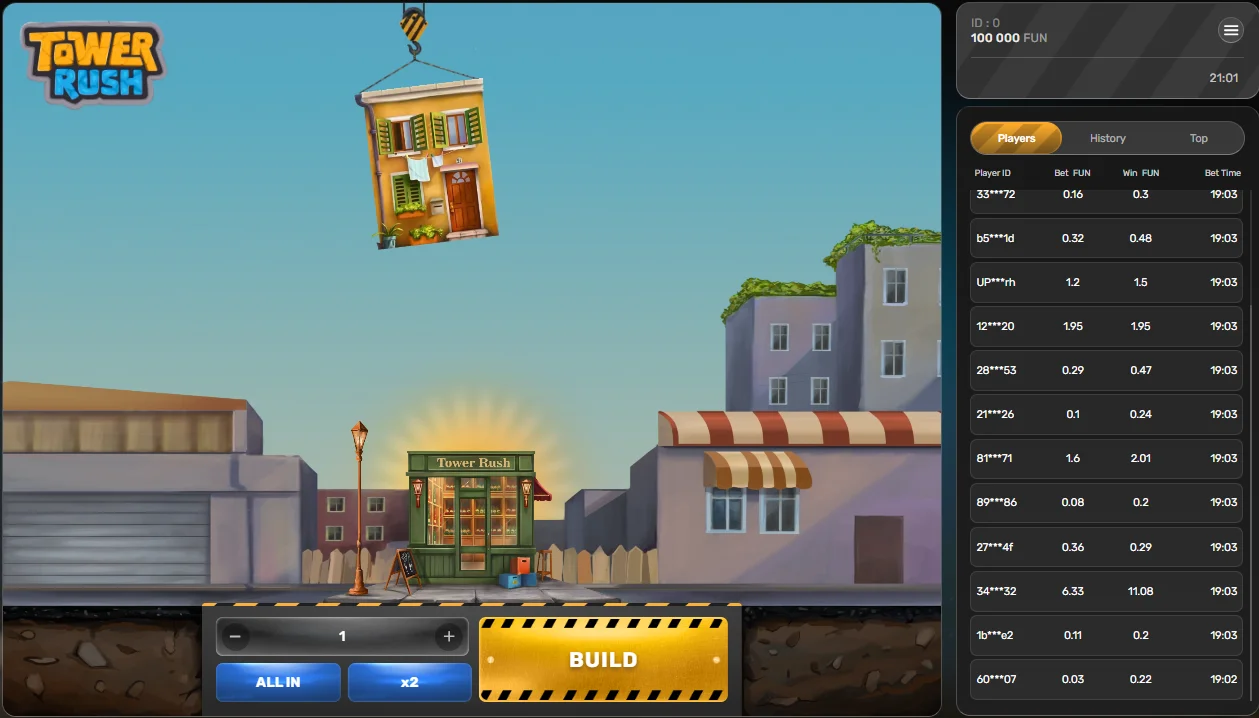
Tower Rush invites players to a unique crash gaming experience where you aim to cash out before the tower collapses, featuring exciting mechanics and a solid RTP.
In summary: Tower Rush is a crash game by Galaxsys that combines suspense with strategy. With a Return to Player (RTP) ranging from ninety-six point fifteen to ninety-seven point five percent and a maximum win potential of one hundred times your stake, players can wager between point one and one hundred. A demo version is available for testing.
Game Details
| Type of game | Tower Rush |
|---|---|
| Developer | Galaxsys |
| Risk level | Medium-High |
| Top payout | x100 |
| Wager range | 0.1 - 100 |
| RTP | 96.15–97.5% |
| Launch date | 06/13/2026 |
| Category | crash-style game |
Tower Rush takes the crash-game format and swaps the thin line that normally climbs across the screen for a building. In Tower Rush, the multiplier still rises, only now it takes the form of storeys piling up, each one adding value and each one leaving the structure a touch shakier.
All of the tension lives in that picture. How tall the tower gets is your call, and so is the moment you leave with whatever it is worth. Hold on for one storey too many and down it goes, along with the money riding on it.
The sections below follow Tower Rush from its origin to your first wager. First the studio and the genre, then each feature more or less in the sequence a newcomer meets it, then the published numbers, access, and the everyday routines for keeping spending in check.
Three special floors, an automatic exit and a band of RTP figures all turn up along the way. So does an honest account of what can and cannot be said about a random game, which deserves as much attention as any feature.
Galaxsys, the studio behind Tower Rush
Galaxsys develops Tower Rush. It shapes the mechanics, drafts the rulebook and releases the figures describing the game's behaviour, among them the RTP band discussed later.
Taking wagers is not part of its job. That falls to online casinos stocking Galaxsys titles in their lobbies. The casino holds a gambling licence, manages your account, receives deposits, processes withdrawals and makes a few choices of its own, notably the version it installs plus the stake limits it allows.
Seeing those two roles clearly answers many questions before they arise. Anything about your balance, a slow withdrawal or a document request belongs with the casino. Anything about floors, collapses or payouts is covered by the rules the studio supplies alongside the game.
That distinction is useful for spotting trouble, too. A developer is not a gambling venue, so a website posing as Galaxsys's personal casino, or offering to sell entry to Tower Rush in the studio's name, deserves a sceptical look.
Treat any claim of inside information about upcoming rounds with equal doubt. Developers never distribute such tips, and a game built on random outcomes leaves nothing to distribute.
A 2026 release in the crash family
Tower Rush reached casino lobbies in 2026. It sits within crash gaming, a corner of the instant-game world where one figure keeps growing throughout a round, may halt without notice, and leaves you with a single real decision: when to get out.
Instant formats cut out the lengthy preliminaries found elsewhere. A round kicks off, runs briefly, and finishes either with you collecting or with nothing. The next can begin at once.
Pace is much of the appeal, and also why money needs watching: a long run of rounds can pass in very little time, and totals creep upward quietly.
Inside its genre, this title pictures the climb differently. Progress appears as a structure gaining height instead of a plotted curve, giving both the swelling multiplier and the swelling danger a shape your eyes can track.
Strip away the visuals and the genre's logic remains intact. A number grows, nobody knows where it stops, and you balance staying against leaving while the round keeps moving.
Tower Rush design built around a tower
Each Tower Rush round starts from bare, empty ground: a plot with nothing on it and a multiplier still at rest.
Floors then arrive, one atop another. With every addition the multiplier ticks up, so greater height means a bigger payout should you collect there. Yet that very same addition also lifts the danger that whatever comes next topples everything.
A collapse ends that round immediately. Should it happen while you are still in, your wager is forfeited. No refund comes back, and the floors which stood briefly earn nothing by themselves.
Collect beforehand and things are equally simple. Your wager comes back multiplied by the figure shown at that instant, and the round ends in your favour.
The design therefore repeats one question endlessly: does another floor justify the added exposure? Tower Rush gives no hint. Collapses can strike low or high, and the height achieved so far reveals nothing about which.
Seeing a tower climb may feel like watching a pattern emerge. No pattern exists. Every round is its own draw, and each new floor owes nothing to those beneath.
The first screen: setting a stake
Before anything is built, you choose your wager. Depending on how the casino configures Tower Rush, that amount can be as low as £0.09 or as high as £85 per round, so one game accommodates a careful first attempt and a heavier commitment alike.
What matters most here is less the ceiling than your own budget. Something that seems minor once becomes substantial over dozens of brief rounds. Picking a wager equal to only a thin fraction of what you set aside for the session means several early collapses won't finish things inside five minutes.
Two documents also deserve a look now, since nobody wants to hunt for them mid-climb. One is the rulebook for whichever version is installed, holding its RTP and related figures. The other covers any bonus conditions linked to your balance.
Every casino writes its own bonus terms. They might count crash titles only partly toward wagering, exclude particular games outright, or cap how much you may stake per round while a bonus balance remains active. Reading them first spares you an unwelcome discovery when withdrawing.
Placing floors and watching the multiplier
With your wager confirmed, construction begins. The multiplier follows the floors upward, and whatever value is showing tells you what collecting would pay right now.
An illustration makes the sums concrete, using numbers chosen solely for demonstration. Imagine wagering £3.4, then collecting when the display reads x2.75. Multiply 4 by 2.75 and you get £9.4 back.
Nothing there suggests some specific floor equals x2.75, nor that Tower Rush will reach it during any given round. It merely demonstrates how wager and multiplier combine at the point you collect.
Notice what that illustration omits. No floor count is given, since that changes from round to round. Neither can it reveal whether holding on would have paid more or ended in rubble; either was possible.
Here decisions feel most personal. Certain players fix an exit beforehand and honour it. Others respond as the building grows, and that is where trouble usually begins: several more floors in pursuit of something bigger, then several more again.
Chasing towering multipliers ranks among the commonest ways sessions fall apart. Big values do occur, yet nobody can name in advance which round brings one, and hunting for it typically costs more than it returns.
A calmly chosen exit, settled before anything rises, generally works better than a guess made in half a second while the tower wobbles.
Cash-out controls in Tower Rush
Collecting turns a climbing figure into money you actually keep. Tower Rush provides two routes, plus a handful of points worth keeping in mind for both.
Manual collection. Available whenever the tower still stands. The payout is your wager multiplied by whatever figure is displayed as you act. Auto cash-out. Before play, you name a target multiplier. If the tower gets there intact, collection happens automatically with no further input needed. Nothing after a fall. Once a collapse occurs, that round is finished and the wager is lost with it. Collecting requires an upright structure. Discipline by design. Auto cash-out works well as a brake. Fixing a target early removes the urge to push for extra height under pressure. Targets aren't predictions. Naming a value makes reaching it no likelier. Even a modest target may go unmet if the collapse arrives sooner. Haste is expensive. Snap choices made as numbers race upward tend to be the session's worst. A short pause between rounds is often enough to fix that. Check before trusting. Each version's rules explain exactly how both methods behave, so read them before leaning on either.
Neither method alters a round's odds. They differ only in who decides: you, in the moment, or the target you set earlier.
Three special floors in the design
Some floors are anything but ordinary. Three special types may surface mid-round, each changing what follows in a distinct way.
| Floor | Role in the round |
|---|---|
| Frozen Floor | Shields the gains already banked at its height |
| Temple Floor | Alters how the multiplier moves from there |
| Triple Build | Changes multiplier movement in its own way |
Frozen Floor is simplest to understand. Once it shows up, whatever winnings you had reached at that level become secured. Put plainly, value gathered so far gets protection, applied exactly as the installed version's rules spell out.
The remaining pair works on the multiplier directly. Each has distinct behaviour, shifting the figure's path compared with a regular floor. Their precise values aren't released as universal numbers; every version lists them in its rulebook, the sole dependable source.
So what does a Tower Rush round featuring one of them look like? Early on, much like any other. Empty ground, rising floors, a growing multiplier. Then a special floor appears and its effect kicks in from there, while your central decision stays unchanged: continue or collect.
Whether one turns up belongs to each round's random result. You cannot organise a session around waiting for one, and a previous round that included a special floor tells you nothing about the next.
Treating them as cues to stay longer is tempting. Seeing them as variety is wiser. The collapse risk attached to every fresh floor doesn't vanish because something unusual happened further down.
Before staking real money, find out what your version's rules say about all three. A quick look there beats any amount of guesswork.
RTP versions chosen by casinos
RTP stands for return to player: a theoretical share of total stakes paid back across an enormous quantity of rounds. Galaxsys sets the published band for Tower Rush from 96.15% to a maximum of 97.5%.
Why a band instead of a single figure? Because the studio supplies more than one version, leaving each casino to install whichever it prefers. The applicable value hinges on that choice and is printed among the rules of whatever version you load.
Two consequences follow. One game may carry different RTP values at different casinos. And the only percentage relevant to you is the one shown inside the version currently open, never one spotted somewhere else.
Knowing what RTP leaves out matters too. Being an average stretched over countless rounds, it says very little about one evening's play. Short sessions can finish far above or far below it, and neither result signals a fault.
A value nearer the upper end implies a slightly thinner theoretical house margin. It changes nothing about how an individual round unfolds and makes collapses no easier to dodge.
Volatility and win limits in the rules
Volatility describes the typical spread of results: whether returns tend toward frequent small sums or rarer, bigger ones. Tower Rush has no single published label for it; every version describes its own within the in-game rulebook.
Likewise for the highest multiplier and largest attainable payout. Every version records those in its own rules, and those entries are what apply to you.
Looking them up before a session pays off. A win limit caps what any round can return, which affects how sensible a sky-high auto cash-out target really is. The volatility note, meanwhile, hints at how bumpy your balance might look over an evening.
Neither number appears here, since neither is published as one fixed value.
Demo mode for Tower Rush
A no-cost Tower Rush demo, played with virtual credits, is available at many casino sites. Whether one is offered, and whether logging in is needed first, varies from casino to casino.
Demo rounds behave like paid ones, except that the credits are worth nothing in cash. Free play is therefore a fine place to watch the mechanics without risking anything: floors rising, the multiplier tracking them, auto cash-out firing, a special floor appearing.
It also suits testing habits. Choose an exit point, stick to it for twenty rounds, noting each time you feel like abandoning it.
One caution about demo results. A lucky streak on virtual credits forecasts nothing for real-money rounds, and an unlucky one forecasts nothing either. Rounds are independent in both modes, so free play teaches the game rather than previewing any particular result.
Playing on phones, tablets and computers
Tower Rush plays straight through a browser on handsets, tablets and desktop computers alike. Nothing needs downloading; you launch it from the casino's website using whatever browser you normally rely on.
Connection quality counts for more than hardware. Rounds go by fast, and losing signal at an awkward instant is irritating, so a dependable network makes sense, particularly over mobile data.
Smaller displays pose their own difficulty. A tower that spreads comfortably across a monitor must squeeze onto a handset, and a hurried tap can easily land off target.
Setting an auto cash-out value before each round eases that problem, because no rushed manual choice on a cramped screen is then required.
Licensed casinos running Tower Rush
Playing Tower Rush for money happens solely at licensed online casinos stocking Galaxsys games, and solely for players who are at least 18.
Three checks come first when picking a casino: a valid gambling licence, stake limits matching your budget, and whether that casino may legally accept players where you live. Gambling law differs between jurisdictions, so being able to load a site doesn't make it open to you.
From there, the route is brief. Open an account, complete the operator's identity checks, fund your balance, then locate Tower Rush where the lobby groups its instant or crash games.
Unlicensed operators are best skipped entirely. They provide no dependable recourse when payouts stall, and some run copies of popular titles whose origin nobody can verify.
Playing Tower Rush with limits
No Tower Rush round depends on another, and every result is random. Many early collapses in a row never leave a tall tower owed to you, and several big collections don't mean the next round will match them. No pattern can flag an approaching collapse.
That single truth demolishes a whole market of false promises. Predictor software, bots, paid signal channels and supposed hack apps all claim foreknowledge of what happens next. None has it, since nothing exists to foresee. Several are simply schemes for harvesting fees, personal details or casino passwords.
Practical limits do far more good. Settle on a spending cap and a session length beforehand, and keep both fixed. Take regular breaks; quick rounds merge into one another, and stepping away restores perspective.
Most licensed operators supply deposit caps, session timers and self-exclusion. Switching them on while relaxed is much easier than scrambling for them during a downswing.
Chasing losses deserves its own warning. Raising stakes to recover a shortfall is among the fastest routes from a poor session to a harmful one.
When gambling turns stressful or simply stops being enjoyable, contacting a professional help organisation makes sense. Getting support early genuinely helps.
Before the first floor
- RTP is tied to whichever version is installed. The published range runs 96.15% through 97.5%; the precise figure appears in whichever version you load.
- Any collapse costs that round's wager. Nothing is returned once the tower falls while you are still in.
- Volatility, the highest multiplier and the biggest payout are all documented in each version's in-game rules. Check them instead of assuming.
- Nothing you do can guarantee a win. Systems, signals and predictors cannot foresee random outcomes, whatever their sellers say.
- Real-money rounds are for people aged 18 or older only, at licensed casinos carrying Galaxsys titles.
- Fix your budget and session length before staking anything, not halfway through an evening.
How a crash works
Comment placer un pari
Commencez par placer un pari dans la plage autorisée de zéro point un à cent.
Comment effectuer un pari
Lorsque le jeu commence, la tour commence à s'élever, avec le multiplicateur augmentant à mesure que des niveaux sont ajoutés.
Comment aborder un tour
Vous devez décider quand encaisser avant que la tour ne s'effondre pour assurer vos gains.
Unique features
L'encaissement automatique permet aux joueurs de définir un multiplicateur prédéterminé pour encaisser automatiquement.
Les modes de difficulté offrent différents réglages qui peuvent affecter le rythme et le risque du jeu.
Le jeu prouve son équité en garantissant que les résultats du jeu sont transparents et vérifiables.
Game comparison
| Type of game | Developer | RTP | Top payout | Risk level |
|---|---|---|---|---|
| Tower Rush | Galaxsys | 96.15–97.5% | x100 | Medium-High |
| Aviator | Spribe | 97% | Unrestricted | Elevated |
| Crash | BGaming | 97% | Unrestricted | Elevated |
| Rocketon | Galaxsys | 96.5% | x5,000 | Elevated |
Benefits & drawbacks
Pros
- A maximum win potential of one hundred times the initial stake offers significant rewards.
- The medium-high volatility means players can expect a mix of small and larger wins.
- The game has a solid RTP that ranges from ninety-six point fifteen to ninety-seven point five percent.
- The ability to wager from a low amount makes it accessible for all players.
Cons
- The game's mechanics may not appeal to those preferring more complex gaming options.
- Players may find the tension of cashing out stressful during high multipliers.
- Some users have mentioned that the game can feel repetitive after extended play.
Eager to engage with Tower Rush?
Play responsibly. This game does not involve real stakes — intended for players 18 and older. Always verify your local laws regarding gaming.
Try the demo versionCommon inquiries
Why is Tower Rush called a crash game?
Because it shares that genre's core structure. A multiplier grows throughout each round, the round may stop suddenly at an unknown point, and your payout depends wholly on collecting first. Here, the sudden stop happens to look like a building giving way.
Does the tower always start empty?
Yes. Every round starts on vacant ground with no floors in place. Nothing carries forward from the round before, whether it finished with a collection or a fall, which is one visible reminder that each round is self-contained.
Can a casino change the RTP?
A casino picks the version it installs, and every available version falls inside the band Galaxsys publishes. The figure for your copy is listed among its rules.
Is there sound or a download?
No download is needed. Tower Rush loads in the browser of a phone, tablet or computer, directly from the casino's website.
Does Triple Build add floors?
It is a special floor that alters how the multiplier travels. Its values appear in the rulebook of every version, together with a precise account of its effect.
Can I play Tower Rush in a mobile browser?
Yes, on phones and tablets alike. Since the game runs inside the browser, any app or APK presented as a mandatory download for it should raise suspicion. Installing files from unverified sources can expose your device and personal data, and offers nothing browser play lacks.